Yuba Raj DC
Nepal is a geo-politically small landlocked country. It can be compared among 235 countries in size all over the world. In this regard Nepal is 95thcountry in the world, 28th in the Asia and 4th in the South Asia in size. The world land covering by Nepal is 0.03% and 0.3% covered in Asia where is a landlocked country rounding by three directions; East-West-South by the Republic by India and one – North by the Peoples Socialist Republic of China. Whole area of Nepal is 1,47,181 Square kilometers beside of the land of Lipulake-Limpiyadhura which is belongs to Nepal as per the agreement of Nepal and former British-India Company on “Suaguli Shandhi” (Sugauli Treaty) held in 1816.

Nepal is a Federal Democratic Republic country having Federal Parliamentarian multiparty system. Kathmandu is the Federal capital of Nepal. There are 7 provinces, 77 districts, 6 Metropolitan cities, 11 Sub-Metropolitan cities, 276 Urban Municipalities, 460 Rural municipalities and its total 753 local Governments in Nepal. Nepal is following federal democratic republican system under federal multiparty parliamentary form. The political governing under republic multiparty federal democratic system is vested in the Nepal‘s constitution 2015 after second revolution in 2005. By highlighting policy in current constitution, the foreign policy of Nepal has included since its historical archives for unification period by Super King Prithvi Narayan Shah then Rana regime, in terms of theme and nationality.
On the other hand, Russia word was originated by “Rus” a Slavonic word. “Rus” word is also created by Finish word “Ruatsi”. However, Ruatsi word is became by Swedish word “Rowers or Sea Farers”. This Russia word means a Swedish caste who is swimming as sea passengers at the time. Thus “Russia” word took as a Russian country in the past, became the First USSR and then Russian Federation.
Russian Federation is the largest sovereign country in the world. It consists of mainly East Europe plain, North plain, south plain Moscow basin, Ural and West Siberia. Going back to history of Russia, Union of Soviet Socialist Republic-USSR was formed in 1922 after the great October revolution in 1917. Geographically, the terrain of Russia is a broad plain with low hills in west. It has vast forest and tundra in Siberia region. Its highest point is 5,642 meters high in Mount Elbrus. The lowest point is -28 meters in Lake Baikal. The Russian Federation is physically the largest country in the world. It covers 17 million square kilometers which is 1.8 times bigger in the size than United States. The territory covers 11 time zone and expansion nearly 6000 miles from West to East. The population is about 147.5 million. The Russian Federation is physically a union of 89 constituents of republic regions and territories which are political independent from Federal government in Moscow. Moscow is the largest city of Russia. It is 25 feet to 815 feet above from sea level. Saint Petersburg, Yekaterinburg, Sochi and Vladivostok are other main cities in Russia. Environmentally, the climate is not same in whole territories. Russia is a big country which encompasses from East to West in the North Pole of the Earth. So, the climate is also diverse types from region to region in Russia. Such as humid climate in Siberia, sub- arctic climate in North area, Tundra climate is almost all parts in Russia and snowfalls from October to March. The temperature is -40F in winter season and +30c in summer season and snow level in certain areas is nearly 2 feet high in surface.
Russia has occupied a frontal geo-political position in the world issues. It is not only today but also in the time of Soviet Union period. So, its effect has been shown itself in the global matters in the international forum. It had already been the biggest country before ex-Soviet empire departed. It has combined a Commonwealth of Independent States (CIS) for an economic, political and military alliance between most ex-Soviet States. Those countries in which Russian Federation is a super country; included other CIS countries like Kyrgyzstan, Kazakhstan, Uzbekistan, Tajikistan, Belarus, Armenia, and Azerbaijan. The Russian Federation is leading its CIS members.
Russia has played the most important role to protect image of small countries which are either developed or undeveloped countries. These countries view Russia positively to any international issues. Small middle countries support Russia at the time of voting in international arena. Russia mainly paves the posterity of each country. Russia goes against terrorism, armed conflict and violence to maintain world order for peaceful globe. Russian soldiers great sacrifice protected its territories and their motherland during the 2nd world war in 1945. Russian soldiers have a great spirit and commitments as great patriots and heroic people in the world. As a result, they won victory in 1945. Therefore, they celebrate “Victory Day” at 9th of May in each year across the Russian Federation.
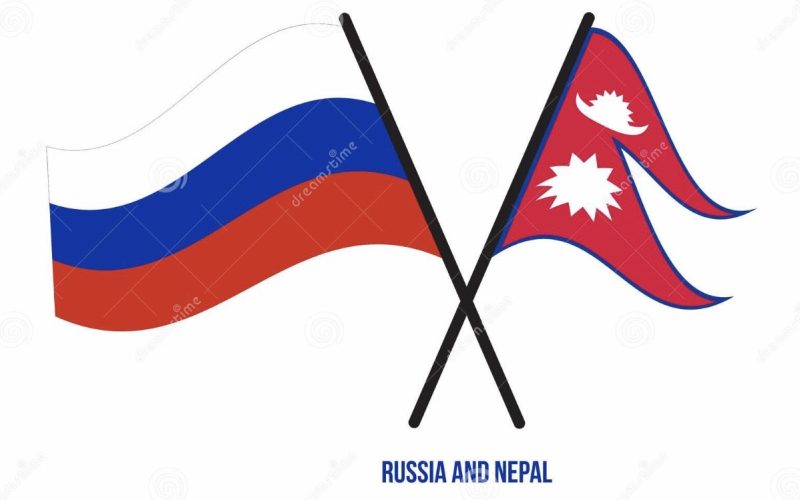
In conclusion, geo-politically Nepal is small landlocked country whereas Russia is the largest in the world, has occupied one-tenth of all the land on earth. Both Nepal and Russia have mountains and glaciers. These two nations have differences on geographical and history, culture and scientific levels. However, national interest is the main bottom line of foreign policy to both countries. At present, both nations have focused on their own national interest rather than mutual cooperation. Therefore, both countries should maintain mutual cooperation to promote existing relations through diplomatic activities in the phase of economic diplomacy.
References: DC, Yuba Raj (2022) Political Relation between Nepal and Russia, (Thesis) Central Depart of Political Science, TU
Note: the Author of this article is Researcher, Critic, Thinker, Writer, Editor, Content Creator, Leadership Trainer