Mr. Yuba Raj D C

The painful story of women in Badi caste in many districts of Nepal is heart touched. For the sustain of life, many women in Badi communities have become forceful to accept the profession of prostitution due to poverty. On 27 October, 2021. I, writer went to Bajhang district to write the life story Badi Women.
Suffering from the pain of what to eat and what to bring daily, the women of the Badi community keep their little children in the hope that Baba (Father) will bring them something sweet. Even old people keep on asking if their son will bring anything…..?
They do n’t know how much they will earn by Sarangi Reter, the professional musical instrument for Males in Badi Community. The money earned can be spent on salt oil to cover the body of children who are difficult to read and teach is a far cry.
“In the song with the padam Badis of Chainpur, he narrates his pain in this way,” “It was difficult to raise a child and to throw a swan in the river.” “
The government announced the sexual abuse and rehabilitation of the women of the Badi community in 2008 AD, but it has not been implemented yet. After the women of the Badi community fought for their rights in front of the Singha Durbar for 48 days from September 1, 2007AD, the Cabinet of Ministers decided to free them from sexual abuse and rehabilitate them. But even after many years of the announcement, it has not been implemented, the plaintiff communities living in different parts of the Nepal are still facing problems. Rights activists say that in the absence of rehabilitation, women from certain communities are still forced to engage in the clandestine sex trade to earn a living.
The woman who must accept prostitution her name is Pushpa Badi, the outgoing vice-president of the Badie Community upliftment Development Committee, said they were still forced to settle on undeclared lands, river banks, roadsides and forest fringes due to lack of rehabilitation.
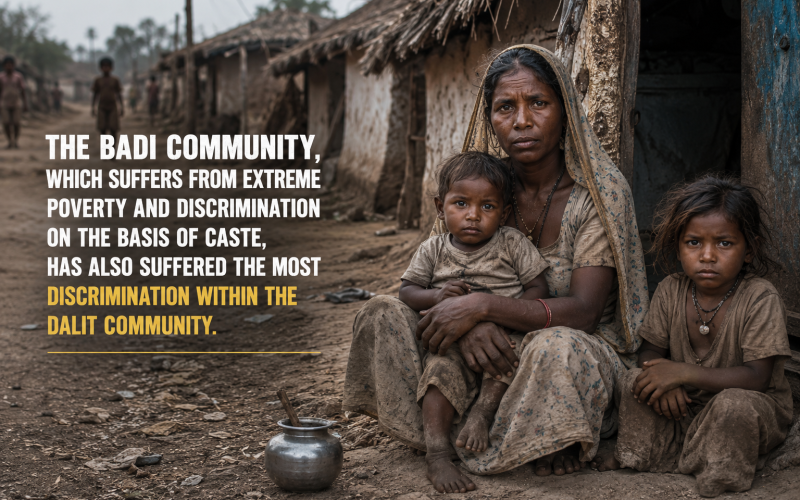
She said, “Now about 40 percent of the plaintiff families are homeless and the remaining 60 percent are living on the declared land. The Badi community, which suffers from extreme poverty and discrimination on the basis of caste, has also suffered the most discrimination within the Dalit community.”
The Badis live in the districts of Dang, Kailali, Salyan, Rolpa, Bardiya, Surkhet, Bajhang and Banke. Umadevi Badi, the president of the National Badi Rights Struggle Committee, who came to the discussion in a half-naked procession from the state for the uplift of the community, warned that the government would fight hard again by harassing them in the name of rehabilitation. Likewise,those who have a husband earn the expenses of the house by playing the sarangi, but the story of those who do not have a husband is very sad. Radha Badi of Chainpur says that they are addicted to flesh trade as they do not get more than Rs 100 to Rs 200 even if they get wages.
“The plaintiff community complains,” “Neither the government looks at us nor the district government looks at us.” Now there is Dalit quota, backward quota in the state, but we are never able to get this quota. “
Writing slogans in big letters on red cloth saying that they have to work for the emancipation of the poor, the slogan processionists have sold their lack and built big palaces, but there has been no change in the life of the poor humble Dalit plaintiff.
Bajhang’s headquarters is not the same as the courtyard of those living in the Baddi settlement of Chainpur. Kesari says that the plaintiffs, who were hiding their lives under the roofs of straw, zinc and tile, had to live up to 70 people in 10 houses.
In order to save their art and culture the Badis of Bajhang have also formed Badis creative committee but till now they have not been helped by Radha Badis.
Representatives of many organizations came to their settlement and distributed sweetmeat dreams also. So now they do not even want to tell the story of their life to others. The plaintiff woman Sukila has been narrating her pain to Mukila.
“Dila Badi, while humming her pain from the song, says, “I try very hard to send children, I cry when I ask for money to buy a copy,” “this piece of song is speaking the pain of many like her.” “A woman cries out in pain,” “Do not be afraid to die, even if it is only for two days or two nights.”
Although the government has provided free education to poor Dalit students, such victims have not yet been able to get this facility. The Badi community, which lives a nomadic life earning a living from dancing, has been engaged in making pottery, including sulpa, hookah, chillim, earthenware, as well as fishing for a living.
Note: The writer is Vice President / Chief of Department of Foreign affairs for Nepali Writers Association, Estd. 1951 AD